
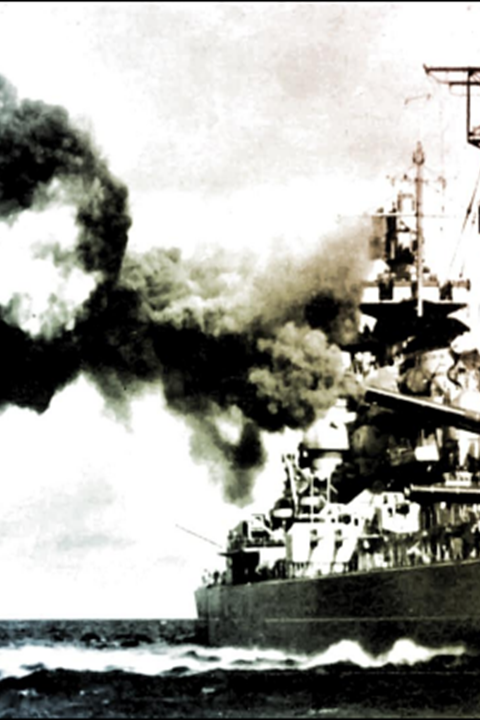
The German Battleship Tirpitz
“Late in 1938, Germany embarked on a plan – PLAN Z – which was designed to provide Germany with a battle fleet of such power that by the late 1940s it would be able to challenge the might of the British Royal Navy.
The proposed fleet of battleships and aircraft carriers looked very good on paper; however the war they were designed to dominate began almost a decade too soon, leaving the Kriegsmarine with only two of their battleships in building, these being the mighty Bismarck and Tirpitz, ships so powerful that no single adversary could be certain of defeating them in a one to one engagement.
In combination with the burgeoning U-Boat fleet, these two huge ships had the capacity, if used wisely, to sever the Atlantic convoy lifeline that effectively kept Britain in the war. But instead of setting sail as a single immensely powerful unit, Bismarck, the first to become operational, was sent into the Atlantic in the company of only the heavy cruiser Prinz Eugen – an error of significant proportions, as history would soon prove. So great was the panic engendered by Bismarck’s solitary foray into the North Atlantic, that a major proportion of the Royal Navy’s assets were diverted from already urgent tasks to bring her to book. In the event she was indeed caught and sunk, but only after the kind of loss and lengthy chase, that would later colour reactions to the prospect of her sister-ship following in her footsteps.
Perhaps only a minor consideration at the time was Bismarck’s intention, having been damaged by air attack, to steam for the occupied French Atlantic port of Saint-Nazaire for repair within the Forme Joubert, one of the largest dry docks in the world and the largest within reach of the Atlantic wastes. Later, however, in considering Tirpitz’s intentions, the presence of this huge dock would assume critical proportions, it having been judged that, were this dock to be destroyed, Tirpitz might not, after all, commit herself to a sortie whose only result might be her own destruction.
German U-Boats and warships usually ‘worked-up’ in the relative safety of the Baltic Sea. When ships and crews were considered fit for action and declared operational, they left the Baltic and, given the extreme dangers inherent in trying to force the English Channel, sailed for their Atlantic operational areas via the North Sea and either the Iceland-Faeroes Gap, or the Denmark Strait. For Germany’s heaviest ships the first ports of call would be on the Norwegian coast where were to be found maintenance and supply facilities, and deep fjords within which to hide from watchful eyes.
When, Tirpitz passed through the Kiel Canal on Wednesday 14th January, 1942, and made for Norway, the spectre therefore arose of her breaking into the Atlantic, joining with the Battle-Cruisers Scharnhorst and Gneisenau, then in Brest, and, in conjunction with the predations of the U-Boats, executing a potentially terminal strike against the convoy supply lines which were vital to Britain remaining in the war.
Given that, were Tirpitz to sustain damage requiring dockyard facilities, she would either have to return to Germany via a North Sea certain to contain a waiting British fleet, or, as with Bismarck, head for the occupied French Biscay ports, a plan was immediately called for that would at least deny her the use of the Forme Ecluse in Saint-Nazaire.
Constructed specially for the luxurious ‘Blue Riband’ liner Normandie, and now more popularly known as the ‘Normandie’ Dock, the Forme Ecluse had long been a target of strategic interest, but one whose defences, both man-made and natural, had thus far defeated every attempt to find a way of overcoming them. Too small to be destroyed from the air, yet, with caisson gates weighing in at 1,500 tons when ballasted with sea-water, much too strong to be destroyed by torpedoes alone, its powerful and growing gun defences only added to the security provided by its position six miles inside a river estuary where extensive shoals confined any approach to a single, narrow, deep-water channel.”
© James Dorrian. Used with permission.