
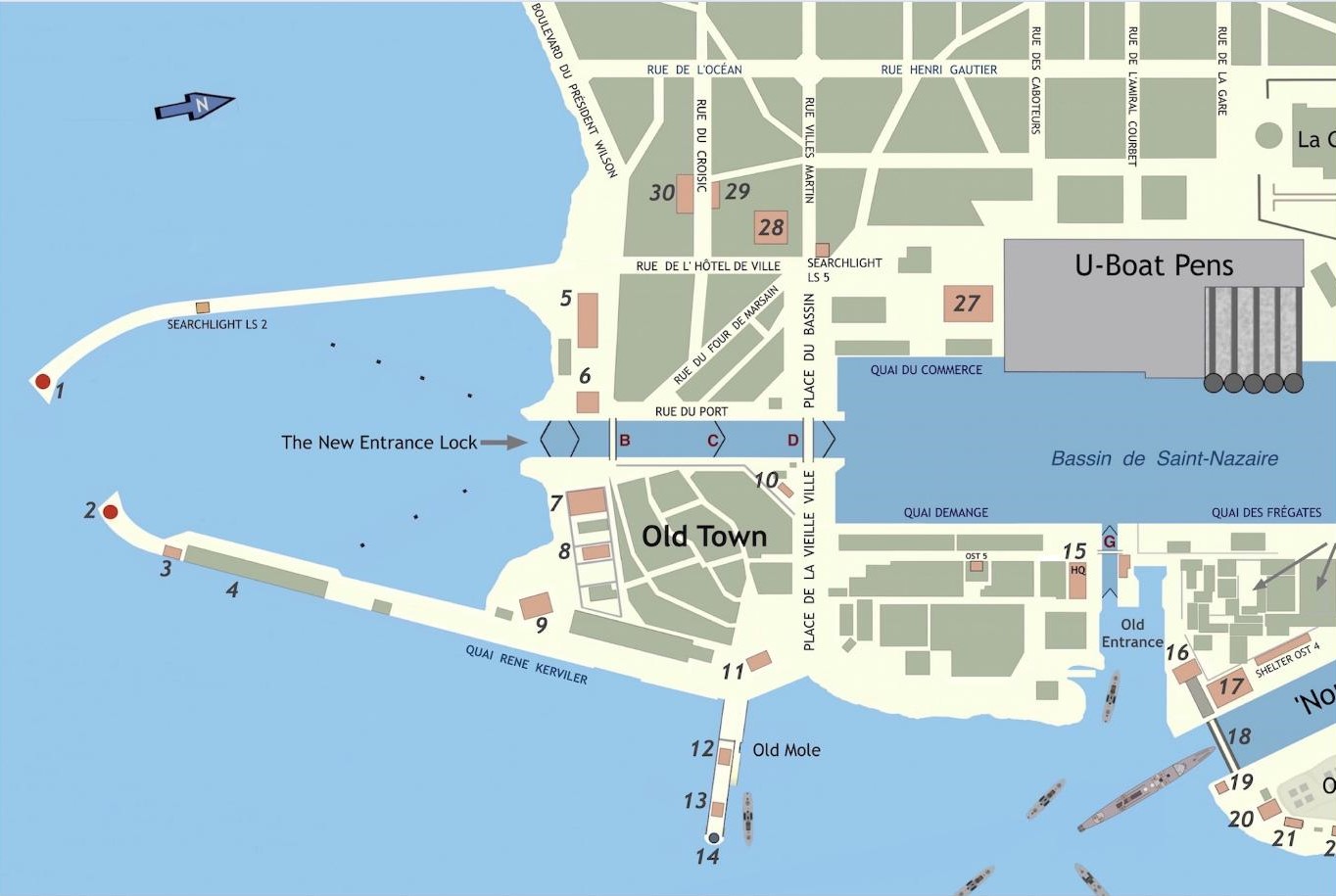
Town Plan of St Nazaire
“Unarmoured, fuelled by petrol and carrying only single 20mm light cannon, the little ships had no way of defending themselves effectively. Many burst into flames as their fuel tanks were hit: others circled helplessly as they tried to land troops at positions already blocked by the wreckage of those that had gone in first. Of six launches attempting to come alongside the fortified Old Mole, only one succeeded in putting men ashore. Nor was the situation any less fraught at the second landing site in the Old Entrance, where a mere two troop-carrying boats managed to disembark their men. Only at the dry dock was success achieved in full with Campbeltown, by dint of her steel hull and her officers’ exemplary skill, surviving the maelstrom to disgorge her 78 Commandos onto the dockside.
Scuttled precisely in place, her explosive charge wedged tight against the caisson, this one ship wanted only time for her fuses to activate and blow the massive structure to pieces. Meanwhile her troops surged through nearby German defences, speedily to command the area within which squads of Demolition troops could lay and fire their own charges – in the vital Pumping Station, and in the two Winding Houses which opened and closed the inner and outer caisson gates.
Having practised through endless hours, by day and by night, in the docks of Burntisland, Cardiff and Southampton, the Demolition teams completed their complex tasks well within the alotted time. Immediately they were clear these all-important ancillary targets were blown up – leaving the final great explosion of Campbeltown’s charge to underscore a truly stunning success.
And then came the reckoning. As the depleted teams came together where their commander, Lieutenant-Colonel Charles Newman had established a tenuous HQ in the face of withering fire from enemy in and around the U-Boat pens, they confidently expected to be carried home by the same small boats that had brought them to Saint-Nazaire. Their reaction, therefore, was one of dismay when they saw that their wooden fleet was burning furiously amidst clouds of oily smoke out in the estuary. At this point lesser men might have been persuaded that surrender was the only sensible course of action. However, these were Commandos who, in spite of being surrounded by an enemy vastly superior in numbers, remained confident they still held a potentially decisive advantage in respect of training and offensive spirit, Still full of fight the decision was therefore taken to do things the Commando way – to sieze the initiative, fight through their encirclement and, in small groups, or even as individual soldiers, make their own way to neutral Spain.
With their way into the main body of the town restricted to a single, closely-guarded lifting bridge (which the Germans had neglected to raise), this last element of their task seemed hopeless: and yet in one great charge the survivors shot and bombed their way across and through the German positions. Here, however, dreams of freedom began to crumble in the face of wounds, exhaustion and an almost completely depleted stock of ammunition. Captured singly, or in small groups, by an enemy wary of their prowess, the future for most would lie as PoWs in camps such as Stalag V111B, Spangenberg Castle or, in the case of especially ‘uncooperative’ guests of the Reich, the notorious fortress of Colditz Castle. A total of five men managed to evade capture and make their way back to the UK: others would spend their long years in captivity attempting to follow suit.”
© James Dorrian. Used with permission.