
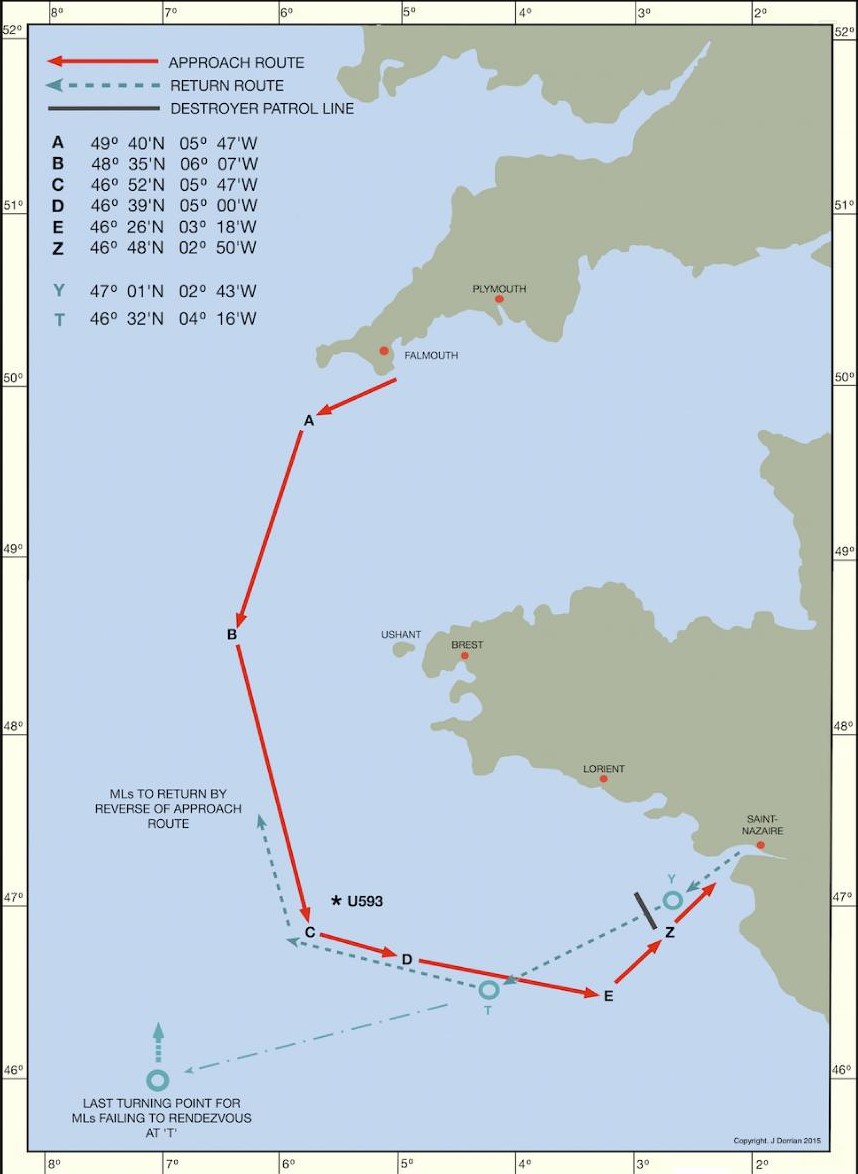
The route to St Nazaire
“Commander Robert Ryder, RN, the Naval Force Commander, having come up with a ruse to deflect the enemy’s attention, the unlikely fleet maintained the pretence of an anti-submarine sweep as it entered the Bay of Biscay. En-route they were actually spotted by an enemy U-Boat which, misinterpreting their intentions, fortuitously reported them as sailing away from the French coast rather than towards it. This was the first in a succession of blunders on the part of an enemy who, convinced of their invulnerability, not only let the Chariot force reach the estuary of the River Loire unopposed, but also let them penetrate deep within it before the defences finally woke to the danger.”
© James Dorrian. Used with permission.
The Voyage to Saint-Nazaire
12.30hrs: 26th March 1942. Executive order ‘CARRY OUT CHARIOT’ received.
14.00hrs: The small boats sail, followed, one hour later by the destroyers Campbeltown,
Tynedale, and Atherstone. Fleet adopts Ryder’s Night Sailing Order (3 columns, destroyers line-astern with Motor Launches (MLs) line-astern, on either side). Note: to conserve their fuel, Motor Torpedo Boat (MTB) 74 and Motor Gun Boat (MGB) 314 were towed by Atherstone and Campbeltown, respectively. Course south-westerly at 13 kts with single fighter cover. Once clear of land, fleet adopts the disguise of an anti-submarine sweep (broad arrowhead of MLs with destroyers arrayed abreast and astern.
19.11hrs: (dusk): At point A. Fighter escort departs. Fleet adopts Night Sailing Order. Course slightly west of south at 14kts.
23.00hrs: At point B. Entering enemy waters, crossing U-Boat transit routes between home bases of Brest, Lorient and Saint-Nazaire, and the Atlantic, plus within range of German airfields based in Brittany. Close watch kept for U-boats with one false sighting.
Dawn, 27th March 1942. Destroyers hoist German Ensigns; MLs haul down and
store White Ensigns.
07.00hrs: At point C. Change course to 112 degrees. Speed 8kts. Adopt anti-submarine
sweep formation. Force spotted by U-593, damaged on patrol and heading for Saint
Nazaire. Tynedale (now flying White Ensign) attacks and U-593 submerges. Tynedale and Atherstone sail south-west to conceal true course of the flotilla.
11.00hrs: Fleet reforms and resumes course 112 degrees.
c. 12.00hrs: At point D. French trawlers sighted and approached in case they carried German observer or wireless. One, the Nungesser et Coli, F.267, is sunk after crew taken on board Tynedale.
14.00hrs: U-593 surfaces and radios sighting of British but gives course as ‘westerly’
resulting in six German destroyers (from St Nazaire), fortunately for the Operation,
being ordered to sea on a fruitless search mission.
20.00 hrs: At point E ships halt, and Ryder and Newman transfer to MGB 314. Force
adopts its 3-column attack formation: MGB 314 in the lead, taking soundings, with port and starboard columns of MLs flanking HMS Campbeltown. Course north-easterly up the Loire estuary. Speed 15kts.
22.00hrs: At point Z, 40 miles from target. Course confirmed by signal from HMSub
Sturgeon. Tynedale and Atherstone detach to patrol and await returning survivors.
Sturgeon departs.
00.25: 28th March 1942: Pass wreck of the troopship Lancastria, sunk in 1940. On time
and on course, just 11 miles from the target – and still undiscovered by the port’s defenders.
© James Dorrian. Used with permission.