Educating the next generation on the St. Nazaire Raid

Operation Chariot was the Raid on St Nazaire, France March 1942 which put the Normandie Dock out of action. It denied Germany use of the largest dry dock in the eastern Atlantic for the rest of the war. So the Tirpitz was not able to sink shipping in the North Atlantic. It is now known as “The Greatest Raid of All”. It was a truly joint operation of the Royal Navy, Army Commandos and the Royal Air Force.

Learn about the raid

Your visit to the new memorial at the National Memorial Arboretum

Please help us by taking a few moments to complete the questionnaire .......

Learn about the "The Greatest Raid of All"

Operation Chariot was an audacious and highly detailed Combined Operations plan to put the Normandie Dock in St Nazaire out of action. On 26th March, 1942, a force of army commandos embarked in motor launches and on HMS Campbeltown, whose bow was packed with explosives, and set sail from Falmouth, covered by the RAF, to destroy the facilities and render them useless to the enemy.

Events Leading up to Operation Chariot

After the Bismarck had sunk
HMS Hood on 24th May 1941 she was hunted down and destroyed by elements of the
Royal Navy, but when initially damaged had signalled her intention to make for St
Nazaire, the only dock on the western seaboard of Europe that could accommodate her.
Realising that such a port could also be a haven for the Tirpitz, should she leave
Norwegian waters for the Atlantic, planners set their minds to destroying the port
facilities, in particular the Normandie Dock.

Planning the Raid

Following the sinking of the Bismarck, Churchill realised it was vital to winning the Battle of the Atlantic to put the Normandie Dock in St Nazaire out of action so Tirpitz could not be repaired on the Atlantic coast, thus keeping her in Norwegian waters
The idea was to use the USS Buchanan, a WWI destroyer, and convert her to look like a German Mowe class torpedo boat. She became HMS Campbeltown. The plan was to pack her with a 4 ton delayed explosive charge and ram the dock gates. Army Commandos from the Campbeltown and accompanying Motor Launches would destroy the Pumping Station, Winding House and other key dock facilities. Success relied on detailed intelligence, deception, precise timing and the heroism of the Charioteers.

The Outward Journey

On 26th March 1942, a force consisting of HMS Campbeltown (a converted former US destroyer) and eighteen small launches of coastal forces, twelve of them carrying commandos, set sail from Falmouth on the 400-mile passage to St. Nazaire accompanied by two escort destroyers, HMS Tynedale and HMS Atherstone. Fighter cover was provided by a single Hurricane.
On the 27th March the force is spotted by U-593 which is attacked by HMS Tynedale and forced to submerge. HMS Tynedale and HMS Atherstone head Southwest to conceal the true course of the British force. U-593 radios the sighting but reports the wrong course resulting in 6 German destroyers being despatched from St Nazaire on a fruitless mission.
As the force approaches the estuary to the Loire its position is confirmed by HMSub Sturgeon. The force moves into attack formation whilst Atherstone and Tynedale depart to patrol and to wait for survivors.

The Approach: Fooling the German Defences

Despite the high Spring tide and that HMS Campbeltown has been stripped to make her lighter she grounds twice on the La Chatelier shoals. The British force is spotted and reported several times, but these reports are disbelieved.
When signalled, the force responds with authentic German signals that were secretly obtained during an earlier raid. The German batteries are confused and sporadic firing ceases.
Finally, the German batteries open fire and HMS Campbeltown hoists the White Ensign. As the British force opens fire, they are already in the harbour approaches and the chance to stop the assault has been missed.

The Attack

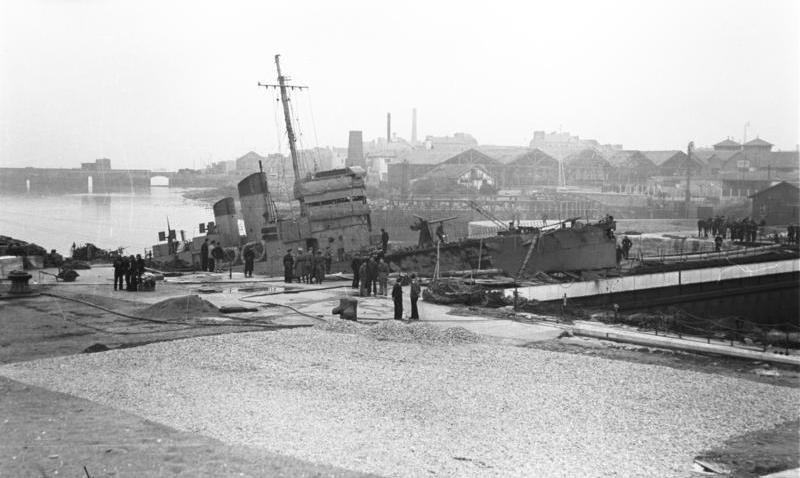
Under heavy enemy fire HMS Campbeltown, fully illuminated by powerful search lights, is repeatedly struck while the little boats of Coastal Forces attempt to fulfil their missions under punishing, point blank enemy fire. When Lt. Commander Sam Beattie realises he is heading for the wrong lighthouse he quickly corrects course, steering Campbeltown at 20 knots through the dock’s protective torpedo net to strike the Normandie dock caisson dead centre, positioning the hidden explosives precisely against the target.
The time is now 01:34, and she is only four minutes late after accomplishing something many believed could not be done.

Aftermath and Remembrance

Of the 625 sailors and commandos involved 169 were lost, many in the burning waters
of the Loire estuary, with 101 of them having no known grave. Over 200 were made
prisoners of war but 239 were able to return to Falmouth. In addition, the RAF lost 9
aircrew. Among the 140 decorations awarded were five Victoria Crosses.
Each year commemorative events are held in St Nazaire, Falmouth (where the Charioteers set off from) and at a London lunch.
The Normandie Dock remained out of action for the rest of the war and the Tirpitz never ventured into the Atlantic.

Resources for learning about the "The Greatest Raid of All"

One of the key objectives of Operation Chariot Memorial Project is to perpetuate the memory of the brave Charioteers, and what they achieved, and to safeguard the accurate story for future generations. Consequently, we are in the process of developing resources for Teachers & Educators, Students and Researchers & Historians.

For Teachers & Educators

The Raid is most obviously of interest under the subject heading of ‘History’. Even so, there are many other aspects which lend themselves to the following areas of learning such as: geography, mathematics, bearings, strategic planning, adapting plans to new circumstances, teamworking & use of initiative, inventiveness / imaginative communication, resilience / survival in difficult circumstances.
Click for materials to use in an education setting.

For Students

Click for engagement activities based on the Raid.

For Researchers & Historians

As part of Operation Chariot Memorial Project, the substantial archives are being digitised together with many oral histories from the descendants of the Charioteers. These will be labelled, catalogued and shortly available in a digital repository.
Click for access to the link.

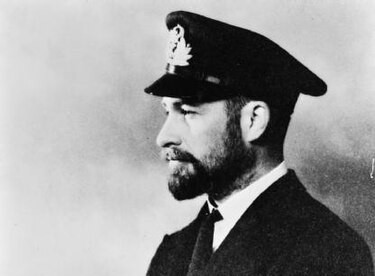
The Captain of HMS Campbeltown

Lt Cdr Stephen Halden Beattie VC
I was interrogated by a German who spoke very good English. He discovered that I had been in Campbeltown and he was remarking that it was no good ramming a stout caisson like that with a flimsy ship - at that moment there was a bang.
Lt Cdr Stephen Halden Beattie VC

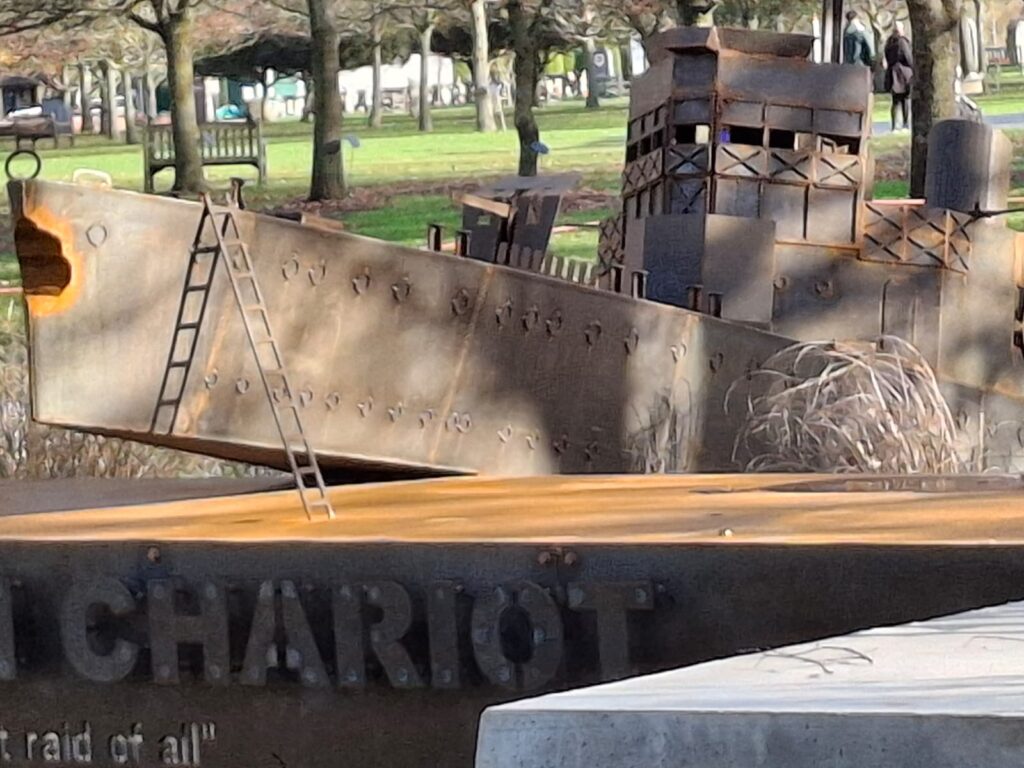
Staffordshire Memorial

The new memorial can be viewed at the National Memorial Arboretum in Staffordshire the Nation’s year-round place
to remember.

  • 0

    How many went on the Raid?

    625 men from the Royal Navy and Army Commandos set off from Falmouth

    St Nazaire Society

  • 0

    How many decorations were awarded?

    140 medals were awarded.

    St Nazaire Society

  • 0 VCs

    How many VCs were won?

    Commander R E D Ryder VC RN, Lt Colonel A C Newman VC, Lt Commander S H Beattie VC RN, AB W A Savage VC RN, Sgt T F Durrant VC

    St Nazaire Society

  • 0

    How many Charioteers were lost or became POWs?

    169 were lost, many in the burning waters of the Loire. 217 were captured.

    St Nazaire Society

Latest News & Resources

For the latest news and to access all of the resources please go to the 'News' and 'Resources' pages in the main menu or toggle between 'News' and 'Resources' on the right and then click on the Button below.

St Nazaire 2026

Afternoon of Friday 27th March at the cemetery in La Baule-Escoublac.
Morning of Saturday 28th March at the Commando Memorial in St Nazaire.
More details to follow.

Falmouth 2026

The annual commemoration in Falmouth is on Sunday 8th March at the Prince of Wales Pier.
More details to follow.

Matching Pairs of Cards

Test your memory with this game and learn interesting facts about Operation Chariot!